This study assessed the effects of bovine colostrum supplementation on hematological and serological parameters as well as on fecal microbiome in twenty adult racehorses. The horses were randomly divided in two groups. The first was perorally supplemented with lyophilized bovine colostrum daily for 30 days, and the second was used as control and had no supplementation. Blood and fecal samples from each animal were collected on day 0 and 30. The results showed that the supplemented group displayed modest changes in some hematological and serological parameters compared to the nonsupplemented group. Lactic acid showed significant difference (p=0.03) between the experimental (2.13±0.24 mmol/L) horses in the experimental group, compared to 3 out of 10 horses in the control group on day 30, which shows a statistically significant increase. (p=0.008). Presence of fungal agents detected at day 30, showed a decrease in the experimental group compared to the initial measurements, specifically, Geotrichum spp. from present in 8 horses, to present in 5 and Mucor spp. from present in 6 horses to absent (p=0.002). The findings suggest that bovine colostrum supplementation had beneficial effects on microbial balance and systemic health adult racing horses.
Horses often suffer from several infectious as well as non-infectious diseases of the gastrointestinal system (
1). Some of the most common gastrointestinal diseases are gastric ulcers, colitis, and inflammatory bowel disease which are of exceptional importance in horse practice (
2).
Colostrum is the first secretion of milk after parturition. It provides important ingredients, essential for the young animals’ health and development. Colostrum is composed of water, carbohydrates, proteins, fats, and minerals. Compared to milk, it contains significantly higher amounts of solids and proteins including zinc, iron, folic acid, choline, riboflavin as well as vitamins A, E, and B12 (
3).
The use of bovine colostrum in horses has already been demonstrated to improve the immune system and performance by reducing the recovery period, stimulating the intestinal microflora population, improving peristalsis and intestinal absorption in racehorses (
4, 5). Additionally, it has been demonstrated to reduce the time of respiratory diseases when used as a dietary supplement in yearling Thoroughbred horses (
6). There are several studies showing that bovine colostrum has a positive effect on the condition of the gastrointestinal tract in animals and humans (
7, 8). Calves are agammaglobulinemic at birth due to the structure of the bovine placenta, which prevents passive transfer of immunity from the mother. As a result, bovine colostrum contains high concentrations of bioactive compounds, especially IgG. In addition, colostrum contains growth factors, lactoperoxidase, lythereforezyme, lactoferrin, cytokines, vitamins, peptides, leukocytes, hormones, minerals, and oligosaccharides (
9).
In humans, colostrum is already used to improve the performance of athletes, reduce the recovery period, reducing the risk of diseases, as well as to improve immune function (
10).
According to the published scientific data, it can be hypothesized that its use can improve immune function and support fecal microflora in racehorses. Therefore, the aim of this study was to determine the effects of bovine colostrum supplementation on fecal microbiota, as well as on hematological and biochemical blood parameters in adult racing horses.
MATERIAL AND METHODSStudy designThe study included 20 healthy, purebred racehorses, 12 of which were mares while 8 were castrated males. Two of the participants were excluded due to health problems unrelated to the study. The horses were randomly divided into 2 groups; the first was supplemented with bovine colostrum for a period of 30 days, while the second groupwas not supplemented and was considered as a control group. The study was conducted at Partynice Racetrack, Wrocław, Poland.
Owner’s consent was obtained for the experimental study on animals and data usage. All examinations were part of routine health monitoring of animals using non-invasive procedures (fecal sample collection). The care and use of the animals in this study were according to the international and national legislative (Directive 63/2010 on protection of animals used for scientific purposes and Poland law based on the Experiments on Animals Act of 15 January 2015), where non-invasive clinical procedures and routine veterinary practices and the administration of registered dietary supplements, are not subject to the ethical review.
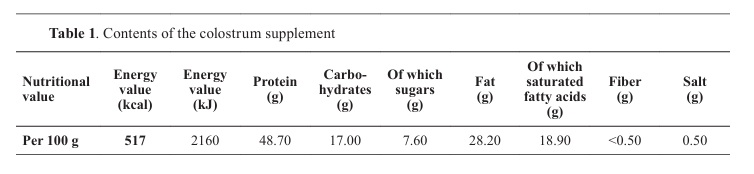
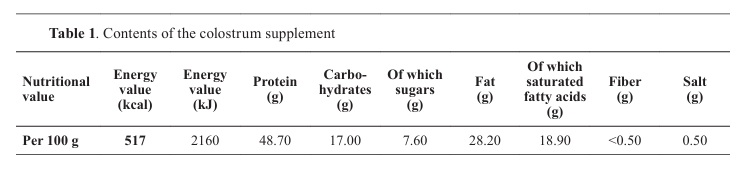
Following clinical examination, blood and fecal samples were collected from each animal on day 0 and day 30 of the colostrum supplementation. The experimental group was orally supplemented with a mixture of lyophilized whole bovine colostrum obtained 2 h after parturition (Genactiv, Bartoszewo, Poland) and banana powder, daily for 30 days. The contents of the colostrum are presented in
Table 1. The supplement was a commercial product that is packaged in sachets of 1 g, containing 500 mg lyophilized bovine colostrum and 500 mg lyophilized natural banana per sachet. 10 g were administered daily per horse.
 Laboratory analyses
The whole blood was analyzed with Vet abc™ hematology analyzer (SCIL Animal Care Company, Germany), while the serum was analyzed with Skyla VB1 veterinary biochemistry analyzer (Skyla, Taiwan). The fecal samples were collected immediately after defecation and were stored in tubes at +4 °C with Faecal TM Enteric Plus transport medium (Oxoid, Basingstoke, England). They were tested on the same day of the sampling for lactic acid bacteria (LAB), total enterobacteria (TCE), total anaerobic bacteria and facultative anaerobes (TCM) in the faces by using De Man, Rogos and Sharpe (MRS) agar, Violet Red Bile Glucose (VRBG) (Oxoid Ltd, Basingstoke, England), and Plate Count Agar (Bio life Italiana Srl, Milan, Italy). The total fecal yeast and mold count (TYMC) was analyzed by using Dichloran Rose Bengal Chloramphenicol (DRBC) agar (Liofilchem, Milan, Italy). Standard pour plate technique was used. The samples were incubated at 25 °C for 5 days. The results were presented as log10 of colony forming units per gram (CFU/g) of the sample.
StatisticsStatistical analysis for the fecal samples was performed with ANOVA (Statistica, Ver: 13.3.721.1) while the biochemistry and hematological data were analyzed by using independent samples T-Tests and Welch’s T-Test on JAMOVI.
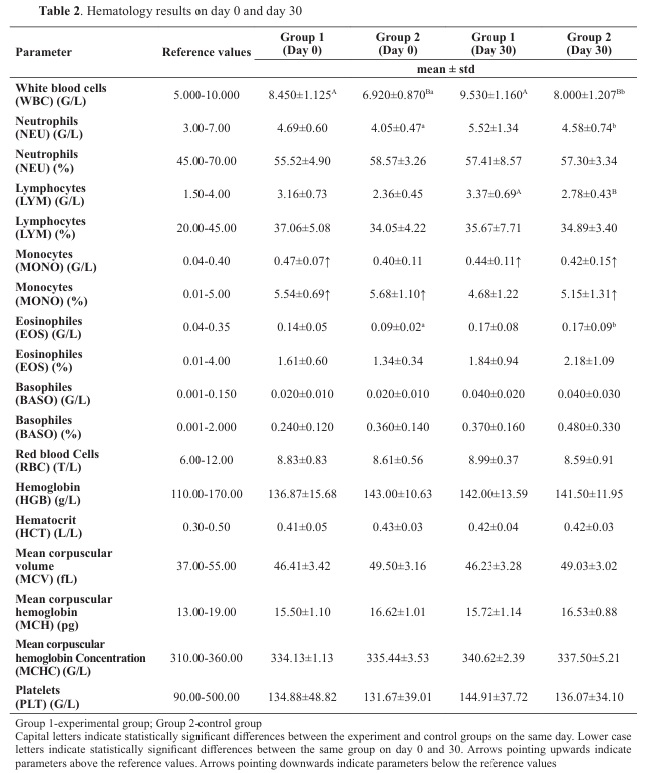
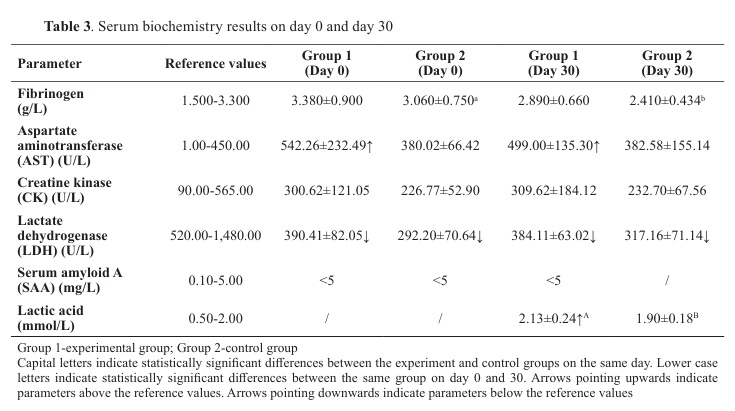
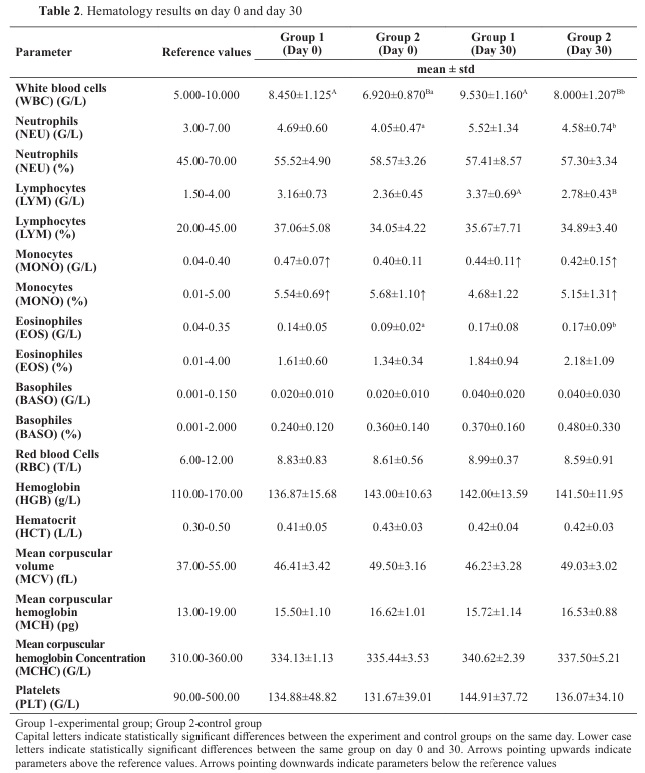
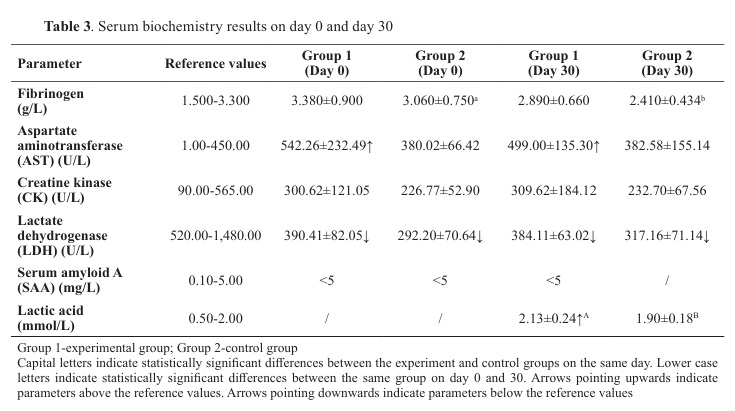
RESULTSMean, minimum, maximum, standard deviation, and reference values for hematological and serum biochemistry parameters are presented in
Table 2 and
3.
The fecal sample pH in group 1 had a mean value of 7.26±0.21, while in group 2 was 7.10±0.27.
Salmonella/ Shigella was not detectedm in any of the 20 samples.
Lactobacillus spp. were detected in 4 horses of the study group (104, 105, 104, >104) and in none of the control group. Aerobic bacteria and
Enterobacteriaceae were detected in all horses.
Geotrichum candidum was isolated in all except one horse.
Mucor spp. was detected in 6 horses of the experimental group and 4 of the control group.
Candida krusei was detected in two horses.
Candida glabrata and
Candida albicans were detected in one horse each.
At day 30, the mean pH in group 1 was 7.20±0.16, while group 2 was 7.14±0.24.
Salmonella/Shigella was not detected.
Lactobacillus spp. was detected in 7/8 in group 1 (>104, >104, >104, >104, >104, >104, 104), while in group 2, it was only detected in 3/10 horses (>104, >104, >104) (p=0.008). Aerobic bacteria were detected in all samples, ranging from 104 to 106 in group 1 and >103 to 106 in group 2.
Enterobacteriaceae were detected in all horses except in two horses and ranged from >102 to >104.
From fungal species in group 1 at 30 days,
Geotrichum spp. was detected in three horses,
Geotrichum candidum in two horses,
Candida krusei in two horses,
Mucor spp. in two horses, and
Penicillum spp., in one horse. In group 2,
Mucor spp. was detected in all horses except two,
Aspergillus niger in six horses,
Geotrichum spp., in one horse, and
Penicillum spp., in one horse. These findings had a statistical significance in group 1 (p=0.002) and in group 2 (p=0.005) compared to the 0 days samples.
DISCUSSIONThe study aimed to evaluate the effects of bovine colostrum supplementation on hematological parameters and gastrointestinal microflora in adult racehorses. Initial bloodwork confirmed the overall health status of the subjects before the start of the trial, ensuring that the observed effects during the study period could be attributed to the treatment rather than pre-existing conditions.
Based on the initial hematological assessments, all individuals in both groups-excluding those removed from the study - were clinically healthy, with values generally within the established reference ranges for the species. At the first sampling of the experimental group, the only parameters that were outside the reference range were the monocytes which were increased by ~17% from the upper reference value, lactate dehydrogenase (LDH) which was below the lower reference value, and AST which was increased above the reference value. The monocyte as well as AST increase appears consistent with other studies which report same increase after periods of training in work horses (
11, 12). The decreased LDH values may be attributed to the fact that the horses were trained, reflecting physiological adaptation to exercise, including more efficient aerobic metabolism and improved muscle membrane integrity. This would result in reduced enzyme leakage and enhanced metabolic stability during workload (
13, 14).
In the control group, LDH deviated from the normal range while monocytes were increased only in relation to other white blood cells. The lower LDH values do not concur with similar studies (
14), while the increase in monocytes is in line with studies which support the finding in horses undergoing training (
11, 12).
During the second sampling, the experimental group showed a general increase in hematological parameters; however, all values remained within the established reference ranges. The exception was monocyte counts, which exceeded the upper reference limit by 10.75%. LDH remained below the lower limit by approximately the same ratio. AST and lactic acid were found to be elevated by a smaller margin. The decrease in monocytes is in line with published literature suggesting an anti-inflammatory effect of bovine colostrum in mice (
15). Studies on mice suggest that bovine colostrum supplementation protects against oxidative stress (
16) therefore reducing lactic acid buildup.
In the control group, some hematological parameters were higher compared to the initial samplings, while others were lower. However, most parameters remained within the normal ranges except for monocytes which were higher and LDH which was lower.
There was also a statistically significant difference between the fibrinogen measurements in the control group on day 0 and day 30, where the mean value was lower on day 30. In both measurements however, the levels remain in the normal reference range. Despite that the parameter is considered diagnostically nonspecific, its increased levels could indicate some underlying acute inflammation which could be an explanation for the difference in levels (
17).
Significant differences in WBC count were observed between the control and experimental groups at both measurement time points. Additionally, a statistically significant difference was found between the two measurements within the control group. No significant difference was observed between the measurements in the experimental group. Hence, it can be assumed that the supplementation had little to no effect on this parameter.
By comparing the parameters between the two groups measured at the end of the study, it can be observed that the experimental group had higher WBC, RBC, as well as AST, LDH, and CK. The concentration of lactic acid in the experimental group was additionally elevated compared to the control group. Lactic acid usually builds up during anaerobic strain in the muscles, which would indicate that the horses were undergoing high intensity training during the experimental period. The higher lactic acid value in the experimental group might be attributable to the faster training recovery effect of the bovine colostrum, hence demonstrating the effect to increase the capacity for high-intensity training in these animals (
5).
Examination of the feces of all 18 individuals revealed the absence of bacteria of the genus
Salmonella as well as
Shigella.
The detection of
Lactobacillus in a subset of the experimental samples suggests its potential role in modifying the microbial population by creating favorable conditions for colonization. These bacteria were not found in fecal samples of the control group.
Total aerobic bacterial count (TCM) showed a higher presence in the control group.
Enterobacteriaceae was isolated in both groups with higher CFU in the experimental group.
The study found lower fungal isolates in the experimental group. Fungi of the genus
Geotrichum are known to infect the gastrointestinal tract in horses (
18). The fungal isolates in the experimental group was lower by 40% compared to the control. These findings may indicate a lower risk of gastrointestinal infection. Additionally,
Candida and
Mucor as opportunistic pathogens (
19, 20), were isolated in lower number of samples in the experimental group. This may indicate a lower risk of general infection by these genera.
The hematological parameter had minor differences between the two groups. However, the experimental group findings indicate enhanced immune status, accompanied by signs of improved liver function. The fecal micropopulation in the experimental group showed balanced ratio. The lower fungal isolates in the gastrointestinal tract of the experimental group indicated lower probability for primary or secondary fungal infection.
CONCLUSIONThe supplementation of bovine colostrum in adult racing horses resulted in favorable gastrointestinal function reflected by abundance of
Lactobacillus in the fecal samples. This effect could be extended by a lower risk of gastrointestinal microbial infection or disease such as colic, gastric ulcers, and colitis. Further studies should confirm these findings with larger sample size and longer term period.
CONFLICT OF INTERESTThe authors declare that they have no financial or non-financial conflict of interest regarding authorship and publication of this article.
ACKNOWLEDGMENTSThe authors would like to specifically express our gratitude to Partynice Racetrack in Wroclaw for volunteering their horses for this study as well as the Wrocław University of Environmental and Life Sciences and Faculty of Veterinary Medicine-Skopje for their support during the research.
AUTHORS’ CONTRIBUTIONAN conceived and designed this study, and along with MP performed the sample collection. DM and EAP performed sample analysis and data interpretation. DM wrote the text. LM and MN performed and checked statistical analyses, respectively.


 10.2478/macvetrev-2026-0024