Original Scientific Article
Comparative reproductive response of Bulgarian Murrah buffaloes to Ovsynch protocol across breeding and non-breeding seasons
Yordanka Ilieva ,
Ivan Fasulkov * ,
Radena Nenova ,
Pencho Penchev ,
Мanol Karadaev ,
Nasko Vasilev

Mac Vet Rev 2026; 49 (2): i - ix

10.2478/macvetrev-2026-0025

Received: 30 June 2025

Received in revised form: 18 August 2026

Accepted: 10 September 2026

Available Online First: 30 September 2026

Published on: 15 October 2026

Correspondence: Ivan Fasulkov, ivan.fasulkov@trakia-uni.bg
PDF

Abstract

The aim of this study was to evaluate Ovsynch protocol efficiency and the effect of season on conception rates in Bulgarian Murrah buffaloes. The Ovsynch protocol was applied in 32 buffaloes during the breeding period (Group I) and 15 buffaloes during the non-breeding season (Group II). Ultrasound scans were performed on day -10, day 0 and day 10 to detect ovarian structures and on day 35 after fixed-time artificial insemination for early pregnancy diagnosis. Blood samples were collected on the 7th and 17th day for assay of serum progesterone concentrations and detection of ovulation stage. Discharge was observed in 59.4% (19/32) of the buffaloes from the first and 33.3% (5/15) from the second group. Pregnancy was detected in 52.6% (10/19) of the animals during the breeding season and in 40.0% (2/5) during the non-breeding season. Openness of the cervical canal was registered in 53.1% (17/32) of animals from first group and in 20.0% (3/15) from the  second one, whereas pregnancy was detected in 23.5% (4/17) and 33.3%, (1/3) respectively. During the breeding season the ovulation rate was detected in 71.9% (23/32) of the buffaloes after the first GnRH treatment, and in 81.3% (26/32) after the second one. In the second group, percentages were lower-53.3% (8/15) and 66.7% (10/15). On the 35th day, pregnancy was detected in 46.9% (15/32) of the buffaloes during the breeding season and 20.0% (3/15) during non-breeding season. Our results showed that the Ovsynch protocol is efficient for estrus synchronisation and fertilisation in both season. The highest ovulation rates are obtained in buffaloes with CL and follicle ≤10 mm at starting of protocol. Ultrasound determination of ovarian structures before starting the Ovsynch protocol will increase ovulation and pregnancy rates.

Keywords: buffaloes, hormonal treatment, estrous synchronization, reproductive response, breeding season


INTRODUCTION

In buffalo farming, genetic progress to increase milk yield can be achieved by applying reproductive biotechnologies previously implemented only in cows. Successful results depend on accurate estrus detection. However, buffaloes rarely demonstrate the characteristic clinical signs of estrus at synchronization and usually are characterized by weak oestrus of variable duration (6–64 h), which makes prediction of ovulation time difficult (1). 
The application of artificial insemination (AI) offers breeders the opportunity to achieve a proper distribution of births during the year and reduce the adverse impact of anestrus. The AI in buffaloes is mainly used after implementing estrus synchronization protocols to improve the reproductive performance (2). The protocols for estrus induction and synchronization comprise the use of various hormones such as gonadotropin- releasing hormone (GnRH), progesterone (CIDR, PRID), estradiol, equine chorionic gonadotropin (eCG) and prostaglandins (PGF2α) (3). Protocols that synchronize the time of ovulation allow fixed-time AI, avoiding detection of estrus by external signs. Factors to consider when choosing a synchronization protocol include the category of animals (heifers, primiparous or multiparous), the reproductive status (cycling or anestrous), and the season (2).
During the past decade, the Ovsynch protocol is implemented in large ruminants for estrus synchronization, resulting in insemination and births within short periods of time (4). The routine use of synchronization protocols with programmed AI is implemented in buffalo farms. The protocols enable the control of the sexual cycle phases, permitting AI without estrus detection and satisfactory fertility during the non-breeding season. The Ovsynch protocol application to buffaloes results in increased ovulation rates and improved fertility when combined with fixed time AI. This protocol achieved insemination rates similar to those of cows inseminated during natural estrus and a reduced calving to first service interval (5).
The lack of studies in the country on estrus synchronization in buffaloes in production conditions gave us reason to plan studies to establish the effectiveness of the Ovsynch protocol in production conditions. We hypothesized that the application of the Ovsynch protocol would result in satisfactory conception rates in Bulgarian Murrah buffaloes and that the breeding season (short-day period) would be associated with higher pregnancy rates compared to the non-breeding season (long day period). In this regard, the study was designed to evaluate the effect of season on the reproductive response to the Ovsynch protocol, rather than to assess its practical applicability under different seasonal conditions.
The aim of the experiment was to study the influence of specific seasonal changes in the ovaries on the fertility of the Bulgarian Murrah buffaloes and to determine pregnancy rates after synchronization and artificial insemination with a fixed time.

MATERIAL AND METHODS

Ethical approval
All procedures were conducted in accordance with the Bulgarian Veterinary Law (25 January 2011) and in compliance with Directive 2010/63/ EU on the protection of animals used for scientific purposes. The experiment was approved by the Animal Ethics Committee of the Faculty of Veterinary Medicine, Trakia University - Stara Zagora.

Animals and experimental design
The research hypothesis of the study was to evaluate Ovsynch protocol efficiency and the effect of season on conception rates in Bulgarian Murrah buffaloes. The animals were reared on the buffalo farm of the Agricultural Institute Shumen (North-East of Bulgaria, latitude: 43.28N, longitude: 26.93E). The ration of buffaloes included concentrate, alfalfa hay, straw, and constant access to water. The study included forty-seven Bulgarian Murrah buffaloes, >45 days in milk, with body condition score 3-4 by the five-point scale (6) and milk yield 1900-2200 L with two milkings per day. The Ovsynch protocol was applied in 32 buffaloes during the breeding period (group I) and 15 buffaloes during the non breeding season (group II).
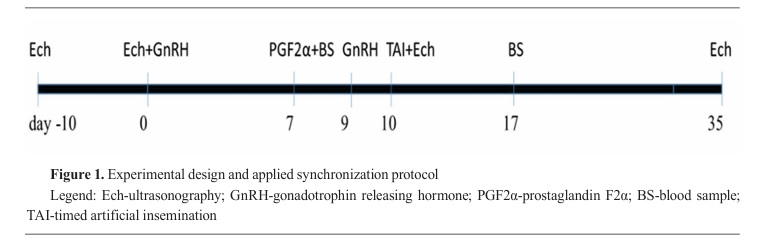
Hormonal treatments with intramuscular injections were as followed: GnRH on day 0; 100 µg Оvarelin (Gonadorelin, Ceva Sante Animale, France); PGF2α on day 7; 25 mg Enzaprost (Dinoprost trometamol, Ceva Sante Animale, France); GnRH on day 9; 100 µg Оvarelin (Gonadorelin, Ceva Sante Animale, France) with TAI 20 h after the last GnRH treatment (Fig. 1). All treatments were performed at 8.00 a.m. of the schedules day. TAI was done by the same insemination technician.


Ultrasonographic examination, cyclic status, blood collection, progesterone analysis
Ultrasound examination was performed with SonoScape S2 Vet ultrasound (SonoScape Co. LTD, Shenzhen, China), using multi-frequency linear rectal probe (L741V, 5.0-10.0 MHz) at a frequency of 7.5 MHz and transrectal approach. Prior to Ovsynch application, ultrasound scans were performed to detect cycling and non-cycling buffaloes on the basis of presence or absence of corpus luteum (CL). For confirmation of non cycling state, a second ultrasound examination was done 10 days apart on animals without CL during the first exam (18), as well as on day 35 after the TAI for early pregnancy diagnosis). Depending on results of last examination, the animals were allotted into three subgroups (A-with CL and follicle ≤10 mm; B-with follicle ≥10 mm; C-with follicle ≤10 mm).
Openness of the cervical canal was assessed at the time of artificial insemination and defined as the degree of cervical canal relaxation allowing passage of the insemination gun through the cervix. The assessment was based on the ease of catheter penetration as an indirect indicator of estrogenic activity. It was evaluated based on the ability to pass the insemination catheter through the cervix (present = easy passage; absent = difficult or no passage) (7, 8).
Blood samples for assay of serum progesterone were collected on days 7 and 17 at eight o'clock in the morning. Serum progesterone concentrations were determined with ЕLISA Huma Reader (HUMAN, Germany), and Progesterone EIA 96 TEST kit (Catalog Number: 6107620; Linear Chemicals, Spain). The test is competitive sandwich ELISA for quantitation of progesterone in biological fluids. Enzyme activity was read at 450 nm on Huma Reader (HUMAN, Germany). The optical density values of tested samples were converted into progesterone concentrations (ng/mL) versus the standard curve. After the application of the first and second GnRH, ovulation was determined on the basis of progesterone (P4) levels: ovulation was accepted as present at levels ≥1 ng/mL and absent at ≤1 ng/mL (9, 10).

Statistical analysis
The results were processed by computer program Statistica version 10.0 (Stat-Soft. Inc. Tulsa, OK, USA). The values of different parameters were presented as relative proportion (%), mean ± standard deviation (mean±SD). Analysis of variance for main effects (ANOVA) was used to estimate the statistical significance of the influence of different factors on the likelihood of pregnancy. The significance of the differences between the mean values for different groups and subgroups was compared using the Chi-square test for comparison of proportions with small samples. A post hoc power analysis was performed based on the observed pregnancy rates between groups. Statistical significance was considered at p< 0.05.

RESULTS

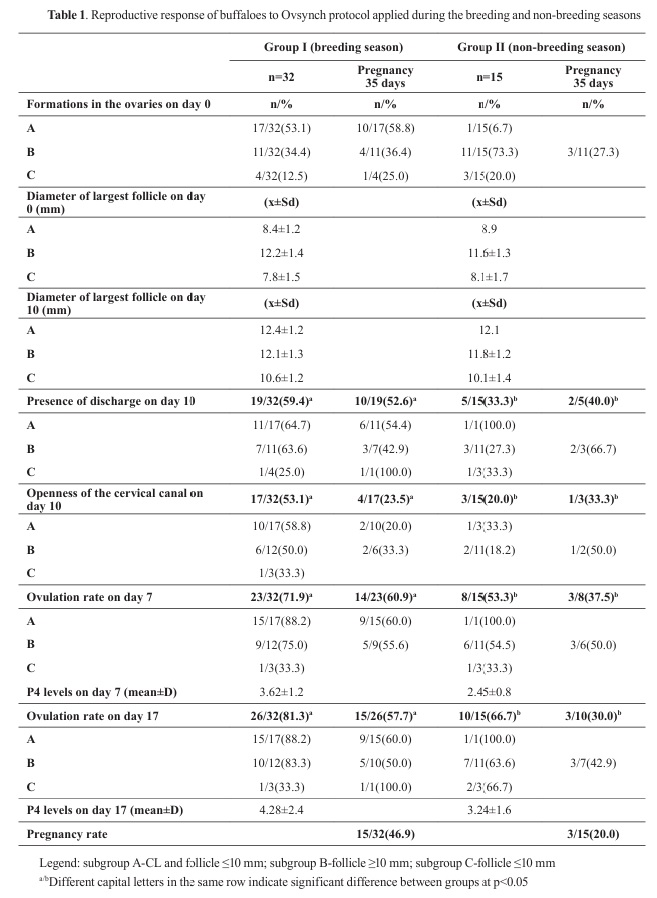
Based on the ultrasound exams conducted at 10-day intervals, the presence or absence of functioning ovarian structures was determined. Results showed that 53.1% (17/32) of the buffaloes treated in the breeding season (Group I) were cycling, while in those in non-breeding season (Group II) only one buffalo was cycling (6.7%, 1/15). The analysis of the results (Table 1) about the structures present in the ovaries at the start of synchronization established that conception has occurred in 58.8% (10/17) of the buffaloes from subgroup A, 36.4% (4/11) from subgroup B and 25.0% (1/4) with a follicle ≤10 mm for the group during the breeding season. During the non-breeding season, conception was registered in 27.3% (3/11) of buffaloes with a follicle ≥10 mm. The presence of discharge and openness of the cervical canal were recorded at the time of the artificial insemination. Discharge was observed in 59.4% (19/32) of the buffaloes from the first and 33.3% (5/15) from the second group. On day 35, pregnancy was detected in 52.6% (10/19) of the animals during the breeding season and in 40.0% (2/5) during the non-breeding season. Regarding openness of the cervical canal, it was registered in 53.1% (17/32) of animals from first group and in 20.0% (3/15) from the second one, whereas pregnancy was detected in 23.5% (4/17) and 33.3% (1/3), respectively. The size of the largest follicles detected on the TAI day did not differ statistically between the groups and subgroups. During the breeding season the ovulation rate was detected in 71.9% (23/32) of the buffaloes after the first GnRH treatment, and in 81.3% (26/32) after the second one. In the second group, respective percentages were 53.3% (8/15) and 66.7% (10/15). On the 35th day, pregnancy was detected in 46.9% (15/32) of the buffaloes during the breeding season and 20.0% (3/15) during the non-breeding season. A total conception rate of 38.3% (18/47) was recorded after implementation of the Ovsynch protocol without taking into account the season as a factor. A post hoc power analysis indicated that the statistical power of the study ranged between approximately 50% and 65%, reflecting a limited ability to detect significant differences between groups.


DISCUSSION

The Ovsynch protocol is the most commonly used for synchronization of estrus and timed artificial insemination in lactating buffaloes. Fixed-time artificial insemination was implemented to overcome the difficulty of detecting animals in estrus and performing artificial insemination in spontaneously ovulating animals at a predetermined time (11). Ovsynch protocol’s treatment with GnRH on day 0 and PGF2α on day 7 induces ovulation of the dominant follicle and regression of the corpus luteum, while a second administration of GnRH on day 9 controls ovulation of the new dominant follicle. The LH surge at a random point in the estrous cycle is triggered by administration of GnRH, which subsequently provokes luteinisation of the dominant follicle (12).
Assay of serum progesterone concentrations is usually used for luteal function evaluation in large ruminants (13). Despite its predictive value, the analysis of blood progesterone is time-consuming and provides only limited information in support of decision-making. The response rate after the first GnRH treatment with dominant follicle ovulation in cycling buffaloes was significantly higher (p<0.05) than in non-cycling ones. The results of the present study are consistent with rates obtained in studies conducted in autumn and winter and in summer (14). High response rates were also reported in other studies performed in autumn and winter as well as early spring (15). These results are explained by the pronounced seasonal cyclicity of buffaloes. Ovulation rates of 90% (9/10) were found in cycling buffaloes, and 62.5% (5/8) in non-cycling buffaloes after the first GnRH injection (15). The variation in response to the first GnRH injection between the studies may be due to variations in the number of animals with dominant follicles at growth stages during the GnRH treatment. This explanation is supported by data that the size of follicles that ovulated or luteinized after the first GnRH application was significantly greater than that of non-responsive follicles. In addition to follicle size, the functional state of the follicle, the developmental competence of the oocyte and steroid environment at the time of GnRH administration are important factors determining the ovulatory response (16).
Several researchers have suggested that follicle diameter at the time of GnRH treatment did not significantly affect the ovulatory response in non-cycling Murrah buffaloes. However, larger follicles with a diameter of >9.5 mm were reported to give a higher ovulation rate than smaller follicles (17). Studies using the Cosynch protocol demonstrated that the follicle diameter and its stage of development at the time of first GnRH treatment are important for its effectiveness, especially when the follicle size was >9 mm, leading to better conception rates (18). The optimal time to start synchronization protocols can be determined by ultrasound identification of ovarian structures (19). The presence of a dominant follicle and an active corpus luteum largely determine the outcome of synchronization. In our study, we recorded a significantly better ovulatory response after the first GnRH treatment in buffaloes with a follicle size ≥10 mm for the breeding and non breeding season respectively, compared to animals with a follicle size ≤10 mm in both seasons. After the second GnRH treatment, ovulation rate in the breeding season was significantly higher (p<0.05) than the non-breeding season. Similar to our results were reported by Ali and Fahmy (15) in Egyptian river buffalo-cows.
The conception rate ranged from 0 to 37% in non-cycling buffaloes during the non-breeding season after application of the Ovsynch protocol (20). In our study, pregnancy was recorded similar values of the treated buffaloes. The unsatisfactory results are most probably due to two main reasons. First, the induction of estrus requires ovulation by both GnRH treatments suggesting that the presence of an LH-responsive follicle >9 mm is a key factor. Second, the CL formed after the first GnRH treatment is short-lived, leading to insufficient progesterone concentrations (21).
Clinical signs of estrus and uterine discharge have been sporadically observed in buffaloes submitted to synchronization. In our study, estrous discharge was found in animals significantly higher (p<0.05) during the breeding season than the non-breeding season. Similarly, higher relative proportion of buffaloes with estrous discharge (74.2%) was reported by Atanasov (22). Oestrous discharge was observed in 40% (6/15) of buffaloes with the Ovsynch protocol and estrous discharge in 20% (3/15) of buffaloes treated with Ovsynch and PRID (23). The absence of estrous discharge in treated buffaloes can be explained by the fact that the period when the follicles reach the ovulation stage is significantly shorter compared to a normal sexual cycle. One of the reasons for the weaker estrus manifestation may be the relatively lower steroid activity of the follicles. The uterus exposure to estrogen is shorter, and consequently, the produced discharge is of significantly lower amount but with increased viscosity (24). Rao and Pandey (25) reported a reduced secretion of 17β-estradiol during the months with long daylight duration. The possibility of existence of preovulatory follicles with reduced estrogenic activity is a plausible explanation for the recorded lower proportion of animals with estrous discharges during the non-breeding season.
Openness of the cervical canal depends primarily on cervical muscles’ relaxation and estrogen-stimulated secretory activity (26). In our study it was found significantly higher (p < 0.05) in animals from the first than these from the second group. These results are close to those reported by Atanasov (27) in buffaloes after application of modified Ovsynch protocol.
The Ovsynch protocol is appropriate in terms of practical implementation and less expensive than exogenous progesterone (PRID)-based protocols (22). Ovulation synchronization rates are within 78.8–93.3% in cycling buffaloes and conception rates range from 42.8% to 60% after a single artificial insemination during the breeding season (14, 15). The results obtained in our study in the buffaloes during the breeding season about ovulation rate and conception rate are close to those published in other studies (13, 28). Lower conception rates (34-40%) were reported in Italian Mediterranean buffaloes, Murrah buffaloes (33.3%), Nili-Ravi buffaloes in Pakistan (36.3% during the breeding season and 30.4% during the non-breeding season) (29, 30). One possible reason for the lower fertility rate with the Ovsynch protocol is the fact that after the second GnRH treatment, ovulation of the dominant follicle is induced before it is fully developed, which results in compromised quality of the oocyte and/or the formed corpus luteum and plasma progesterone concentrations that are low to maintain pregnancy. Reduced progesterone synthesis below the required threshold is one of the causes for embryonic loss in cattle (31) and a similar explanation has been proposed for buffaloes (32, 33). Ali and Fahmy (10) established early and asynchronous ovulation in non-cycling buffaloes which is the main problem with the Ovsynch protocol.
Breeding season has an impact on the conception rate. Baruselli et al. (34) and Warriach et al. (30) reported that the reproductive performance of buffaloes during the breeding season (autumn and winter) was better represented than that out of the breeding season. Heat stress may have an adverse effect on oocyte quality via increased body temperature and reduced blood flow to the genitals. These changes inhibit normal embryonic development and increase embryonic losses (35). 
It is known that when using progesterone-based protocols for estrus synchronization (PRID, CIDR, MAP sponges), a comprehensive understanding of ovulation timing is crucial. In this regard, some authors reported increasing pregnancy rates in postpartum buffaloes, using GnRH administration 84 hours after medroxyprogesterone acetate (MAP) removal (36) and after CIDR-Cosynch protocol (37). Our results indicated that using the Ovsync protocol in buffaloes achieves similar pregnancy rates, especially during the breeding season. Compared to progesterone-based protocols, the Ovsynch protocol is significantly shorter, easily implemented, and less expensive. A post hoc power analysis indicated that the statistical power of the study ranged between approximately 50% and 65%, reflecting a limited ability to detect significant differences between groups. This limitation is primarily related to the relatively small sample size, especially in the non-breeding group. It should be noted, however, that the buffalo population in Bulgaria is considerably smaller compared to cattle and small ruminants, which inherently restricts the number of animals available for experimental studies. Therefore, studies conducted under field conditions in this species are often constrained in sample size. Despite this limitation, the present study provides valuable data on the reproductive performance of Bulgarian Murrah buffaloes, a comparatively less-studied livestock species under practical farming conditions. Although the use of synchronization protocols during the non-breeding season may be less efficient, evaluating their performance under these conditions is important for improving reproductive management strategies in buffalo farming.

CONCLUSION

The analysis of the obtained results showed that the Ovsynch protocol is efficient for estrus synchronisation and fertilisation in Bulgarian Murrah buffaloes during breeding and non-breeding season. A better synchronisation and conception rate were achieved during the breeding season due to the high proportion of cycling animals. The highest ovulation rates are obtained in buffaloes with CL and follicle ≤ 10 mm in the ovaries. In this regard, ultrasound determination of ovarian structures before starting the Ovsynch protocol will increase ovulation and pregnancy rates.

CONFLICT OF INTEREST

The authors declare that they have no financial or non-financial conflict of interest regarding authorship and publication of this article.

ACKNOWLEDGMENTS

This research was funded by the Bulgarian Ministry of Education and Science in the framework of the Bulgarian National Recovery and Resilience Plan, Component “Innovative Bulgaria”, Project No. BG RRP-2.004-0006-C02 “Development of research and innovation at Trakia University in service of health and sustainable well-being”.

AUTHORS’ CONTRIBUTION

YI, IF, NV planed the experimental design. NV, IF and MK performed the ultrasonographic examination of the cows. RN, YI and MK have synchronized the cows. RN and YI collected the blood samples. PP have run the statistical analysis. NV, IF and PP performed the proofreading.

References

1. Srirattana, K., Hufana-Duran, D., Atabay, E.P., Duran, P.G., Atabay, E.C., Lu, K., Liang, Y., et al. (2022). Current status of assisted reproductive technologies in buffaloes. Anim Sci J. 93(1): 13767. https://doi.org/10.1111/asj.13767 PMid:36123790 PMCid:PMC9787342
2. Neglia, G., Donato, De Nicola, D., Esposito, L., Salzano, A., D'Occhio, M.J., Fatone, G. (2020). Reproductive management in buffalo by artificial insemination. Theriogenology 150(1): 166-172. https://doi.org/10.1016/j.theriogenology.2020.01.016 PMid:31982156
3. Kumar, P.R., Singh, S.K., Kharche, S.D., Govindaraju, C.S., Behera, B.K., Shukla, S.N., Kumar, H., Agarwal, S.K. (2014). Anestrus in cattle and buffalo: Indian perspective. Adv Anim Vet Sci. 2(3): 124-138. https://doi.org/10.14737/journal.aavs/2014/2.3.124.138 
4. Pursley, J.R., Mee, M.O., Wiltbank, M.C. (1995). Synchronization of ovulation in dairy cows using PGF2α and GnRH. Theriogenology 44(7): 915-923. https://doi.org/10.1016/0093-691X(95)00279-H PMid:16727787 PMCid:PMC12314792
5. Rabida, S.K., Gofur, M.R. (2017). Synchronization of estrus using ovsynch protocol and fixed timed artificial insemination (FTAI) in indigenous dairy buffaloes: An effective buffalo breeding program in Bangladesh. Asian J Biol. 2(1): 1-8. https://doi.org/10.9734/AJOB/2017/31950 
6. Anitha, A., Rao, K.S., Suresh, J., Moorthy, P.R.S., Reddy, Y.K. (2011). A body condition score (BCS) system in Murrah buffaloes. Buffalo Bull. 30(1): 79-99.
7. Kumbhar, G.B., Markandeya, N.M. (2017). Studies of cervical dynamics in cows and buffaloes. Int J Livest Res. 7(11): 52-58.
8. Ulfa, K., Saputra, H., Arifin, T., Thasmi, C.N., Hafizuddin, H., Etriwati, E., Hamzah, A. (2023). Cervical opening during estrus in Aceh local cows based on camera-equipped artificial insemination endoscope. Ovozoa J Anim Reprod. 12(1): 12-17. https://doi.org/10.20473/ovz.v12i1.2023.12-17 
9. Roy, K.S., Prakash, B.S. (2009). Plasma progesterone, oestradiol-17 and total oestrogen profiles in relation to oestrous behaviour during induced ovulation in Murrah buffalo heifers. J Anim Physiol Anim Nutr (Berl). 93(4): 486-495. https://doi.org/10.1111/j.1439-0396.2008.00830.x PMid:18507697
10. Perera, B.M.A.O. (2011). Reproductive cycles of buffalo. Anim Reprod Sci. 124(3-4): 194-199. https://doi.org/10.1016/j.anireprosci.2010.08.022 PMid:20869822
11. Bó, G.A., Baruselli, P.S. (2014). Synchronization of ovulation and fixed-time artificial insemination in beef cattle. Animal. 8(Suppl. 1): 144-150. https://doi.org/10.1017/S1751731114000822 PMid:24844128
12. Hoque, M.N., Talukder, A.K., Akter, M., Shamsuddin. M. (2014). Evaluation of ovsynch protocols for timed artificial insemination in water buffaloes in Bangladesh. Turk J Vet Anim Sci. 38(4): 418-424. https://doi.org/10.3906/vet-1302-35 
13. Wilsdorf, L.J., Keisler, D.H., Poock, S.E., Lamberson, W.R., Escalante, R.C., Lucy, M.C. (2016). Short communication: Test for nonpregnancy in dairy cows based on plasma progesterone concentrations before and after timed artificial insemination. J Dairy Sci. 99(7): 5858-5865. https://doi.org/10.3168/jds.2016-10864 PMid:27179877
14. Baruselli, P.S., Maduriera, H.E., Barnabe, V.H., Barnabe, R.C., de Araujo Berber, R.C. (2003). Evaluation of synchronization of ovulation for fixed timed insemination in buffaloes (Bubalus bubalis). Braz J Vet Res Anim Sci. 40: 431-442. https://doi.org/10.1590/S1413-95962003000600007 
15. Ali, A., Fahmy, S. (2007). Ovarian dynamics and milk progesterone concen-trations in cyclic and non-cyclic buffalo cows (Bubalus bubalis) during Ovsynch program. Theriogenology. 68(1): 23-28. https://doi.org/10.1016/j.theriogenology.2007.03.011 PMid:17482252
16. Picard-Hagen, N., Lhermie, G., Florentin, S., Merle, D., Freina, P., Gayrard, V. (2015). Effect of gonadorelin, lecirelin, and buserelin on LH surge, ovulation, and progesterone in cattle. Theriogenology. 84(2): 177-183. https://doi.org/10.1016/j.theriogenology.2015.03.004 PMid:25890780
17. Waqas, M., Mehmood, M.U., Shahzad, Q., Kausar, R., Sattar, A., Naseer, Z. (2016). Comparative efficacy of G6G and Ovsynch protocols on synchronization and pregnancy rate in NilieRavi buffaloеs. Anim Reprod Sci. 166, 9-14. https://doi.org/10.1016/j.anireprosci.2015.12.006 PMid:26833275
18. Kumar, L., Phogat, J.B., Pandey, A.K., Phulia, S.K., Kumar, S., Dalal, J. (2016). Estrus induction and fertility response following different treatment protocols in Murrah buffaloes under field conditions. Vet World. 9(12): 1466-1470. https://doi.org/10.14202/vetworld.2016.1466-1470 PMid:28096623 PMCid:PMC5234065
19. De Rensis, F., Lopez-Gatius, F. (2007). Protocols for synchronizing estrus and ovulation in buffalo (Bubalus bubalis): a review. Theriogenology 67(2): 209-216. https://doi.org/10.1016/j.theriogenology.2006.09.039 PMid:17112577
20. Karuppanasamy, K., Sharma, R.K., Phulia, S.K., Jerome, A., Kavya, K.M., Ghuman, S.P.S., Kumar, H., et al. (2017). Ovulatory and fertility response using modified Heatsynch and Ovsynch protocols in the anovular Murrah buffalo (Bubalus bubalis). Theriogenology 95, 83-88. https://doi.org/10.1016/j.theriogenology.2017.02.022  PMid:28460685
21. Sharma, R.K., Singh, J.K., Phulia, S.K., Singh, I. (2009). Hormonal control of ovarian activity, Therapeutic interventions. In: Interactive meet on buffalo reproduction (pp. 46-55). Hisar, India: ICAR-CIRB
22. Atanasov, А. (2015). Reproductive response of buffaloes with ovarian hypofunction after administration of hormone therapy as a function of season and order of parturition [Doctoral Dissertation, Trakia University], 105-107.
23. Malik, R.K., Singh, P., Singh, I.J., Sharma, R.K., Phulia, S.K., Tuli, R.K. (2011). Ovarian response and fertility of Ovsynch-treated postpartum anestrus Murrah buffaloes. Buffaloes Bull. 30(4):272-276.
24. Tsiligianni, T., Amiridis, G.S., Dovolou, E., Menegatos, I., Chadio, S., Rizos, D., Gutierrez−Adan, A. (2011). Association between physical properties of cervical mucus and ovulation rate in superovulated cows. Can J Vet Res. 75(4): 248-253.
25. Rao, L.V., Pandey, R.S. (1983). Seasonal variations in oestradiol-17β and luteinizing hormone in the blood of buffalo cows (Bubalus bubalis). J Endocrinol. 98(2): 251-255. https://doi.org/10.1677/joe.0.0980251 PMid:6683743
26. Senger, P.L. (2003). Pathways to pregnancy and paruration. 2nd Ed. Current conception. Pullman,WA
27. Atanasov, A. (2014). Reproductive response of primiparous and multiparous buffaloes of Bulgarian Murrah breed with ovarian inactivity after GnRH PGF2α-GnRH therapy. Bulgarian J Anim Husb. 51(4): 15-18.
28. Carvalho, N.A.T., Nichi, M., Henriquez, C.E.P., Oliveira, C.A., Baruselli, P.S. (2007). Use of human chorionic gonadotropin (hCG) for fixed-time artificial insemination in buffalo (Bubalus bubalis). Anim Reprod. 4(3): 98-102.
29. Presicce, G.A., Senatore, E.M., Bella, A., De Santis, G., Barile, V.L., De Mauro, G.J. (2004). Ovarian follicular dynamics and hormonal profiles in heifer and mixed-parity Mediterranean Italian buffaloes (Bubalus bubalis) following an estrus synchronization protocol. Theriogenology 61(7-8):1343-1355. https://doi.org/10.1016/j.theriogenology.2003.08.013 PMid:15036967
30. Warriach, H.M., Channa, A.A., Ahmad, H. (2008). Effect of oestrus synchronization methods on oestrus behavior, timing of ovulation and pregnancy rate during the breeding and low breeding seasons in Nili-Ravi buffaloes. Anim Reprod Sci. 107(1-2): 62-67. https://doi.org/10.1016/j.anireprosci.2007.06.007 PMid:17658705
31. Diskin, M.G., Morris, D.G. (2008). Embryonic and early foetal losses in cattle and other ruminants. Reprod Domest Anim. 43(Suppl 2): 260-267. https://doi.org/10.1111/j.1439-0531.2008.01171.x PMid:18638133
32. Campanile, G., Di Palo, R., Neglia, G., Vecchio, D., Gasparrini, B., Prandi, A., Galiero, G., D'Occhio, M.J. (2007). Corpus luteum function and embryonic mortality in buffaloes treated with a GnRH agonist, hCG and progesterone. Theriogenology 67(8): 13931398. https://doi.org/10.1016/j.theriogenology.2007.03.001 PMid:17403533
33. Campanile, G., Neglia, G., Gesparrini, B., Galieno, G., Prandi, A., Diblo, R. (2005). Embryonic mortality in buffaloes synchronized and mated by AI during the seasonal decline in reproductive function. Theriogenology 63(8): 2334-2340. https://doi.org/10.1016/j.theriogenology.2004.10.012 PMid:15826694
34. Baruselli, P.S., Carvalho, N.A.T., Gimenes, L.U., Crepaldi, G.A. (2007). Fixed-time artificial insemination in buffalo. Ital J Anim Sci. 6(2): 107-118. https://doi.org/10.4081/ijas.2007.s2.107 
35. De Rensis, F., Scaramuzzi, R.J. (2003). Heat stress and seasonal effects on reproduction in the dairy cow-a review. Theriogenology. 60(6): 1139-1151. https://doi.org/10.1016/S0093-691X(03)00126-2 PMid:12935853
36. Mehmood, M.U., Chishti, G.A., Waseem, M., Azam, B.E., Naseer, Z., Saadullah, M., Lu, K., Lu, Y. (2024). Preovulatory follicular dynamics and ovulatory events following the use of GnRH 84 h after medroxyprogesterone acetate sponge removal in postpartum buffaloes. J Reprod Dev. 70(6): 349355. https://doi.org/10.1262/jrd.2024-040 PMid:39183041 PMCid:PMC11658920
37. Haider, S., Chishti, G.A., Mehmood, M.U., Jamal, M.A., Mehmood, K., Shahzad, M., Tahir, M.Z. (2021). The effect of GnRH administration/ insemination time on follicular growth rate, ovulation intervals, and conception rate of Nili Ravi buffalo heifers in 7 -day-CIDR Co-synch. Trop Anim Health Prod. 53(6): 558. https://doi.org/10.1007/s11250-021-03003-8 PMid:34860311


Copyright  

©2026 Ilieva Y. This is an open-access article published under the terms of the Creative Commons Attribution License which permits unrestricted use, distribution, and reproduction in any medium, provided the original author and source are credited.

C
onflict of Interest Statement

The authors declared that they have no financial or non-financial conflict of interest regarding authorship and publication of this article.

Citation Information

Macedonian Veterinary Review. Volume 49, Issue 2, Pages i-ix, e-ISSN 1857-7415, p-ISSN 1409-7621, DOI:  https://doi.org/10.2478/macvetrev-2026-0025