This study analyzed the effects of varying relative humidity (RH) on the internal and microbiological quality of eggs stored at ambient temperature (22±2°C) for 28 days. Medium-sized eggs, produced by 60-week-old Lohmann Brown hens (n=30), were selected randomly and allocated into sealed chambers set to 20%, 60%, or 100% RH. Egg weights were measured weekly, while internal quality attributes were evaluated at the conclusion of the storage duration. Eggs stored at 20% RH exhibited the highest weight loss (5.9%), whereas those at 100% RH showed minimal moisture loss (0.39%). Eggs stored at 20% RH also exhibited the highest yolk redness. Compared to 96.7% and 100% in the 60% and 20% RH groups, respectively, only 36.7% of eggs stored at 100% RH remained organoleptically acceptable for consumption after 28 days, based on predefined classification criteria. The 60% RH condition resulted in the poorest albumen structure, as reflected by the lowest Haugh unit scores. The length and width of the albumen decreased at 20% RH, while yolk pH remained unaffected by the humidity level. The yolk index declined as humidity increased. Eggs stored at 100% RH harbored the highest microbial loads, including mold, yeast, and aerobic bacteria, whereas the lowest shell contamination was observed at 20% RH. No significant differences in microbial counts were identified between the 20% and 60% RH groups. In conclusion, storage at low humidity (20%) was associated with better preservation of selected quality whereas saturated humidity (100%) was associated with significant quality deterioration and an increased risk of contamination.
Relative humidity is a critical environmental variable with a dual function: it manages moisture exchange through the eggshell and influences the microbial environment present on the shell surface. These effects subsequently impact on both the physicochemical integrity and microbiological safety of eggs during storage (
9). While low RH accelerates moisture loss from eggs - leading to weight reduction and decreased internal quality - excessively high RH may promote microbial proliferation on the shell surface, thereby risking the integrity of the shell and food safety (
10). Kinetic modeling studies have illustrated that RH has a significant effect on both weight loss and HU, underscoring the importance of regulating RH during storage (
11). Microbial contamination of the eggshell raises additional concerns, particularly when storage conditions favor mold and bacterial growth (
12). The environments characterized by elevated humidity are linked to increased microbial loads on shell surfaces, which may penetrate the shell or contaminate eggs during handling (
13). Despite the paramount importance of microbiological quality, numerous studies have predominantly concentrated on physicochemical and structural changes rather than on microbial dynamics across different RH levels (
14). Extensive research has thoroughly documented how storage temperature and duration affect egg quality. However, few investigations have systematically evaluated how varying RH conditions - such as very low versus saturated environments - impact internal quality traits (including weight loss, albumen, yolk, and HU) and microbial contamination over extended storage periods. This significant knowledge gap is particularly relevant considering the considerable variability in storage environments (e.g., dry versus humid warehouses, regional disparities), where both quality and safety are imperative for consumer acceptance.
The study investigates the effects of storing eggs at three different RH levels (20%, 60%, and 100%) over 28 days, focusing on internal quality indicators such as egg weight loss, HU, yolk index, pH, and color, along with microbiological factors like aerobic bacteria, yeasts, and molds on the shell. The aim is to understand how RH influences the preservation of functional quality and the risk of microbial contamination, ultimately providing guidance for best practices in egg storage for both commercial and household settings.
MATERIAL AND METHODSFresh medium-sized eggs (n=30) were randomly collected from those laid by 60-week-old Lohmann Brown hens and stored for 28 days in an airtight vacuum oven (Nüve EV 018, Ankara, Türkiye) to maintain consistent RH. A total of 90 eggs were individually numbered and weighed, with 30 eggs assigned to each of the three treatment groups (20, 60, and 100% RH). No live animals were used in this study; therefore, ethical approval was not required. The study and data usage were performed with the informed consent and approval of the farm owner, who granted permission for the research and the reporting of the obtained data.
Relative humidity treatmentsA 100% RH environment was established through the saturated water vapor methodology. In summary, a broad, shallow stainless-steel tray was filled with distilled water and positioned at the lower compartment of the vacuum oven. As air enclosed with liquid water at a constant temperature reaches saturation, this technique effectively creates an environment of 100% RH (
15). The vacuum oven door was securely sealed, and the system was allowed to equilibrate for 2 h prior to placing the eggs. Relative humidity levels were continuously monitored with a digital hygrometer (CEM-DT-172, No. 11048007, Shenzhen, China) to ensure humidity remained within the range of 95% to 100% during the entire storage period.
The environment with 60% RH was established using a saturated potassium iodide (KI) solution, a standard method for generating intermediate humidity levels within sealed chambers. A saturated KI solution, containing excess solid crystals, was placed in an open glass tray at the bottom of the vacuum oven. According to the validated humidity reference data, saturated KI has a vapor pressure corresponding to approximately 69% RH at 25 °C, which generally stabilizes within the 60–65% RH range under standard incubator operating conditions (
15). The chamber was allowed to equilibrate for 3 h before the introduction of eggs, with RH continuously monitored via a digital hygrometer.
A 20% RH environment was established utilizing activated silica gel as a desiccant. The silica gel underwent regeneration in an oven at 120–150 °C for 1–2 h prior to deployment, and was then placed in broad, shallow trays positioned around the egg racks on perforated supports to prevent direct contact with the eggs. A calibrated digital hygrometer was strategically positioned at the egg level to continuously monitor RH and temperature. The oven was allowed to reach equilibrium over 1-4 h, after which additional desiccant was added incrementally until the RH stabilized at 20%±5%. Desiccant trays were regenerated or replaced as necessary to sustain the target RH throughout the 28-day storage period. This methodology adhered to established desiccant-based humidity control standards (
16, 17).
Egg quality measurementsEggs were weighed using a precision scale (Sartorius TE3102S, Germany; with an accuracy of ±0.01 g). The percentage of weight loss was calculated by determining the difference between the initial and subsequent egg weights.
The diameter of the air cell within each egg was measured under candling light (Yensan Incubation Machines, Turkey) using a digital caliper (Mitutoyo, UK).
The pH of the yolk was determined utilizing a calibrated digital pH meter (HI83141, HANNA Instruments, USA). Each sample was measured at least twice, with a third measurement conducted in cases of inconsistency. The electrode underwent daily calibration using pH 7.0 and pH 9.0 buffer solutions, was rinsed with distilled water between measurements, and readings were documented upon stabilization.
After breaking the eggs onto a flat glass surface, measurements were performed on the raw albumen and yolk. The height of the albumen was measured at the midpoint between the yolk margin and the edge of the thick albumen employing the same tripod micrometer (
18).
The height of the albumen was measured at the midpoint between the yolk margin and the thick albumen employing the same tripod micrometer (
18). The length and width of the albumen were recorded on a flat glass surface using an electronic caliper.
The HU was computed utilizing albumen height (H, mm) and egg weight (W, g), following the formula established by Eisen et al. (
19): HU=100×log (H−1.7W^{0.37}+7.6).
Color measurementsThe evaluation of egg yolk coloration was performed utilizing a portable colorimeter (Model 3nh-NR100, Guangzhou, China). Before measurement, the device was calibrated using the standard white ceramic tile supplied by the manufacturer. Eggs were broken onto a glass surface, and the colorimeter aperture was precisely aligned with the surface of the yolk. Measurements were obtained at three separate locations on the yolk, with meticulous attention to avoid the yolk–albumen interface.
Color values were measured using the CIE Lab* system, where L* indicates lightness, a* represents the red–green axis, and b* corresponds to the yellow–blue axis. Measurements were performed under a D65 illuminant with a 10° standard observer. For each egg, the average of three readings was used for statistical analysis (
20).
Microbiological analysisThe surface area of each egg shell (3×3 cm²) was swabbed using a sterile cotton swab over a defined template, and the populations of total aerobic bacteria as well as yeast and mold were subsequently determined.
Microbiological analyses were conducted at the beginning of the storage period and after 17 days of storage at ambient temperature (22±2 °C). On day 0, no statistically significant differences in eggshell microbiological counts were observed among the different treatment groups (p>0.05).
Owing to concurrent textural analyses, the reference method ISO 4833-1:2013 for total mesophilic aerobic bacteria was modified (
21). Swab samples collected from a 3×3 cm² eggshell area were inoculated onto Plate Count Agar (PCA, Merck) and incubated at 37 °C for 24-48 h prior to enumeration.
Similarly, the reference method ISO 21527-1:2008 for yeast and mold enumeration was adapted (
22). Swab samples were inoculated onto Yeast Glucose Chloramphenicol Agar (YGC Agar, Merck) and incubated at 25 °C for 5 days. Final results were expressed as colony-forming units per egg (CFU/egg).
All microbiological analyses were conducted in triplicate, and the results were transformed into logarithmic values (log CFU/egg) prior to statistical analysis.
Statistical analysisAll statistical analyses were conducted utilizing IBM SPSS Statistics (Version 26.0; IBM Corp., Armonk, NY, USA). Each egg was designated as the experimental unit (n=30 per treatment). The normality of the data was evaluated via the Shapiro–Wilk test and Q–Q plots, whereas the homogeneity of variances was assessed through Levene’s test.
Repeated-measures ANOVA was employed to analyze variables measured across multiple time points, with treatment serving as the between subject factor and storage duration as the within subject factor. Mauchly’s test of sphericity was conducted, and Greenhouse–Geisser corrections were applied as appropriate. Post hoc comparisons were executed using Bonferroni adjustments.
Single-time-point variables were analyzed using one-way ANOVA with Tukey’s post hoc test or Welch’s ANOVA with Games–Howell correction when variance homogeneity was violated. Nonparametric data were analyzed using the Kruskal–Wallis test followed by Dunn’s post hoc test with Bonferroni correction.
Categorical outcomes were assessed utilizing the Chi-square test or Fisher’s exact test, as appropriate. Pearson or Spearman correlation analyses were conducted contingent upon the data distribution. All statistical tests were two-sided, with a significance threshold established at p<0.05. The results are displayed as mean ± standard error of the mean (SEM).
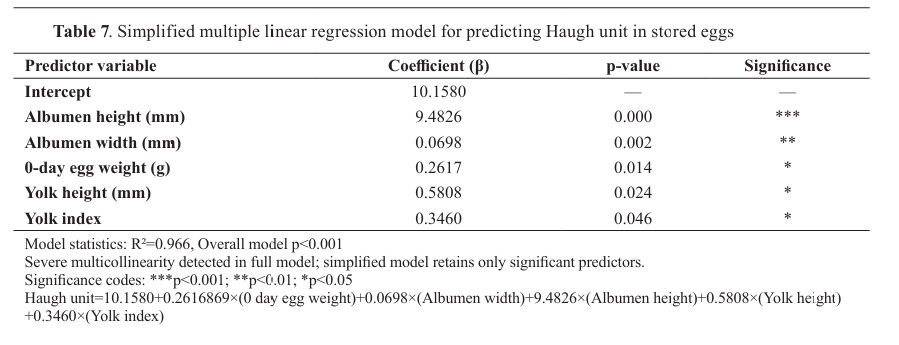
A multiple linear regression analysis was conducted to identify the predictors of the HU. Upon identifying multicollinearity within the comprehensive model, a stepwise elimination method was applied, yielding an optimized model that included albumen height, albumen width, yolk height, yolk index, and initial egg weight. The validity of this model was confirmed by a high coefficient of determination (R²=0.966).
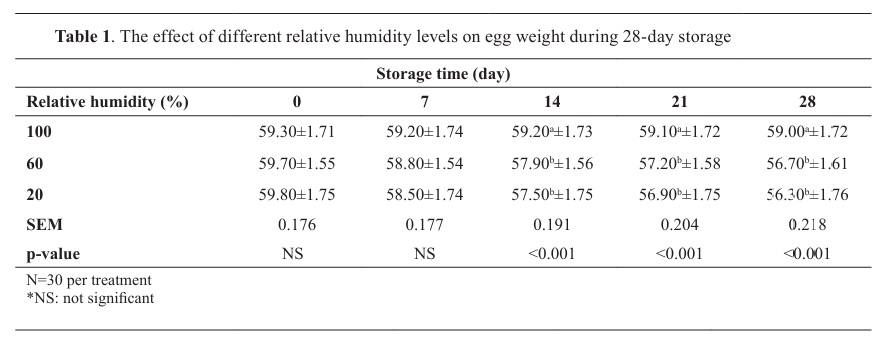
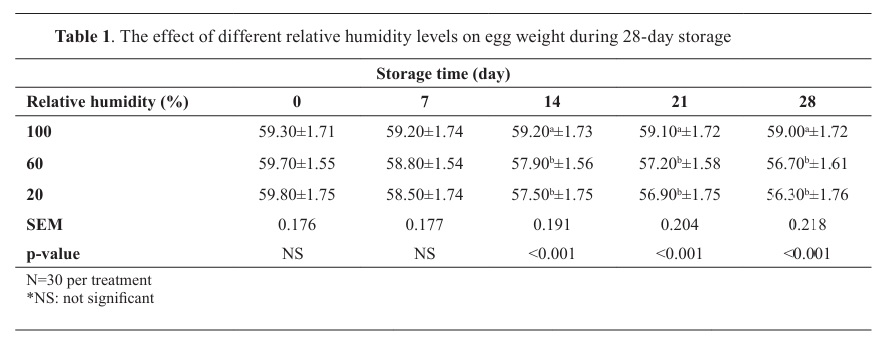
RESULTSEgg weightThe impact of RH on egg weight over a 28 day storage period is presented in
Table 1. Initial egg weights showed no significant differences among the treatment groups (p>0.05). Likewise, no statistically significant differences were observed at day 7 (p>0.05); however, from day 14 onwards, RH significantly influenced egg weight (p<0.001). Eggs stored at 100% RH retained substantially higher weights at days 14, 21, and 28 compared to those stored at 60% or 20% RH. By day 28, eggs stored at 100% RH had an average weight of 59.0 grams, whereas those stored at 60% and 20% RH decreased to 56.7 g and 56.3 g, respectively.
 Percentage egg weight loss
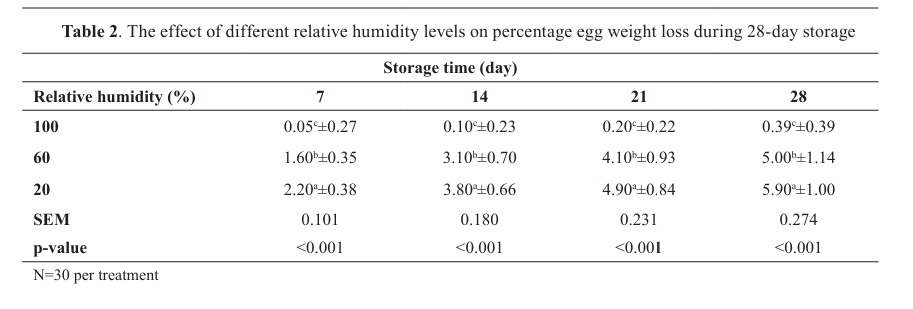
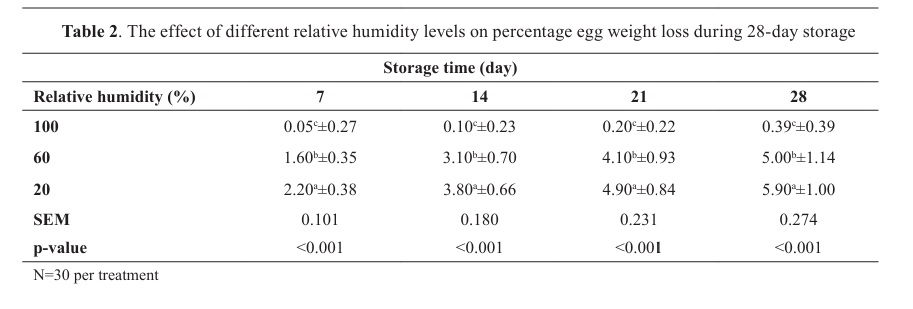
As demonstrated in
Table 2, RH markedly influenced egg weight loss throughout the storage duration (p<0.001 at all-time points). Eggs stored at 100% RH displayed the minimal weight loss during storage, with a cumulative loss of merely 0.39% by day 28. Conversely, eggs stored at 20% RH experienced the greatest weight loss at each assessment point, reaching 5.9% by day 28. Eggs stored at 60% RH exhibited intermediate weight loss values between these two extremes.
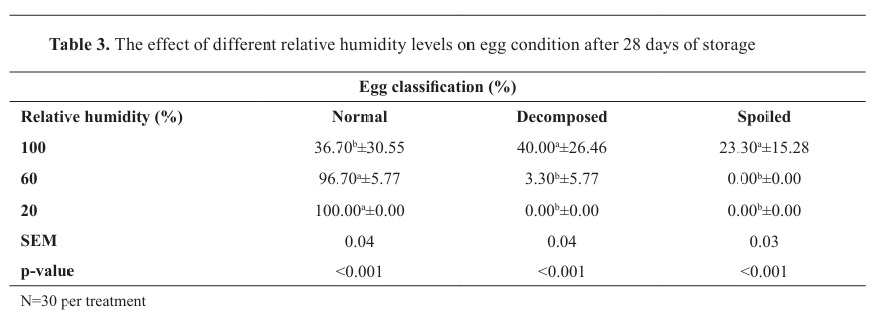
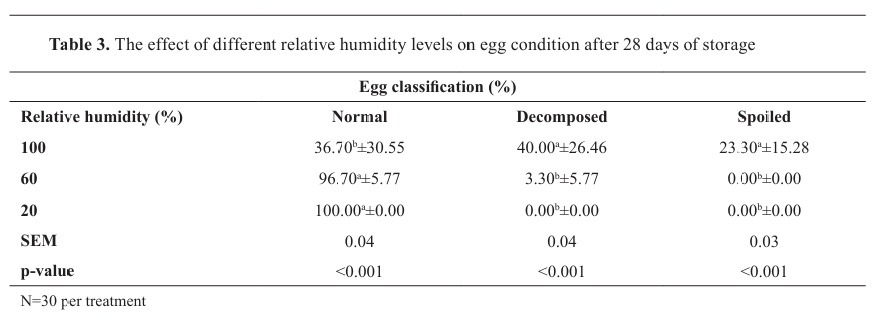
Egg condition after 28 days of storageEgg condition classifications after 28 days of storage are summarized in
Table 3. Relative humidity significantly influenced the distribution of normal, decomposed, and spoiled eggs (p<0.001). The highest proportion of normal eggs was observed at 20% RH (100%), followed by 60% RH (96.7%). Eggs stored at 100% RH showed the lowest proportion of normal eggs (36.7%) and the highest proportions of decomposed (40%) and spoiled eggs (23.3%). No spoiled eggs were recorded in the 60% or 20% RH treatment groups.
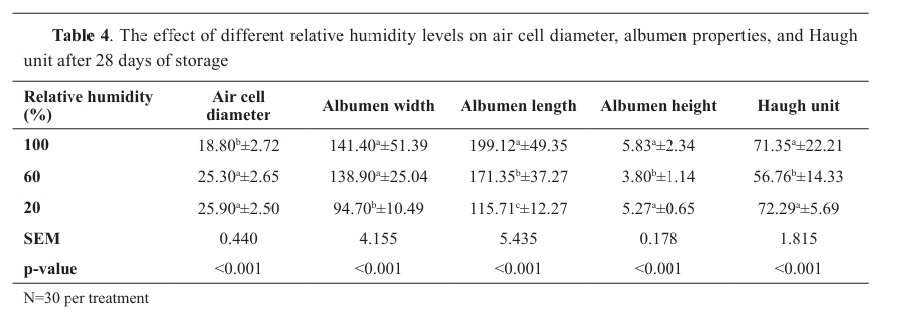
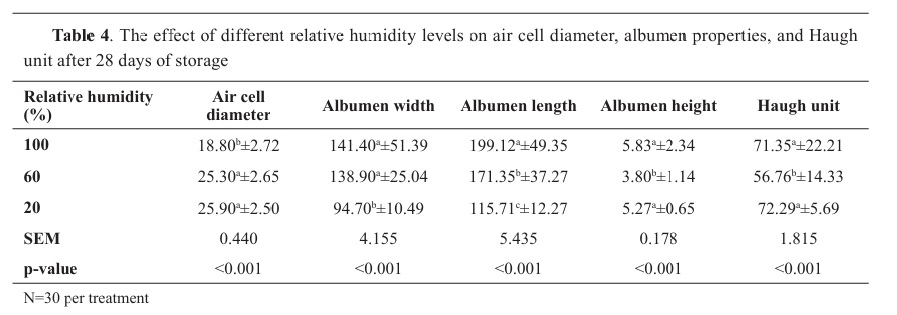
Air cell diameter and albumen qualityThe effects of RH on air cell diameter and albumen characteristics after 28 days of storage are presented in
Table 4. Air cell diameter differed significantly among treatments (p<0.001). Eggs stored at 100% RH exhibited the smallest air cells (18.8 mm), whereas eggs stored at 60% and 20% RH showed significantly larger air cell diameters (25.3 mm and 25.9 mm, respectively).
Albumen length, width, and height were also significantly affected by humidity (p<0.001). Eggs stored at 100% RH showed the highest albumen height (5.83 mm) as well as the greatest albumen length and width. In contrast, eggs stored at 20% RH exhibited marked reductions in albumen dimensions. Haugh unit values differed significantly among treatments (p<0.001), with the lowest value observed at 60% RH (56.76). Eggs stored at 100% and 20% RH maintained significantly higher HU values (71.35 and 72.29, respectively), indicating better albumen quality under both very high and very low humidity conditions.
 Yolk quality traits
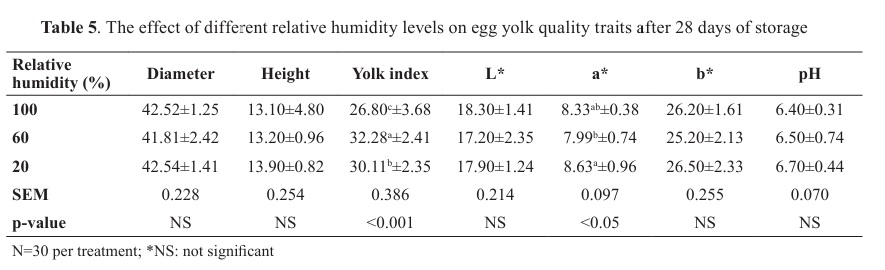
The quality characteristics of the yolk evaluated after a 28-day storage period are detailed in
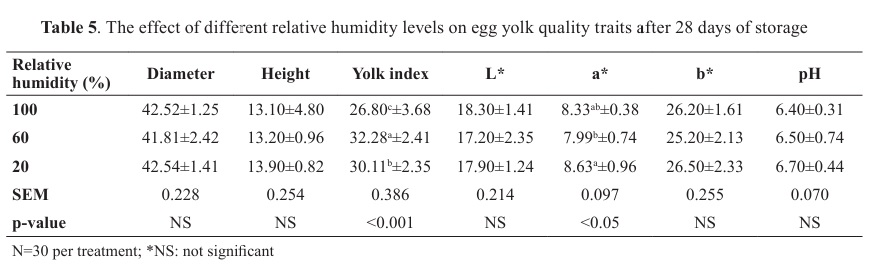
Table 5. Humidity levels did not exert a statistically significant influence on yolk diameter, yolk height, or yolk pH (p>0.05). Nevertheless, the yolk index displayed significant variation among treatment groups (p<0.001), with the lowest observed at 100% RH and the highest at 60% RH. The yolk color parameter a* (redness) was also significantly affected by humidity (p<0.05), with eggs stored at 20% RH exhibiting the highest redness values. Other color parameters, namely L* and b*, were not significantly influenced by humidity levels (p>0.05).
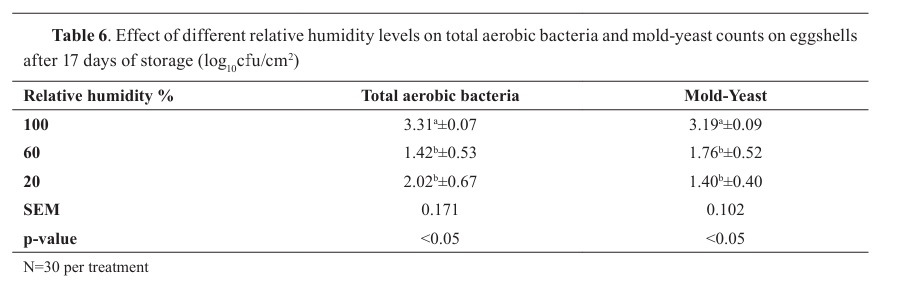
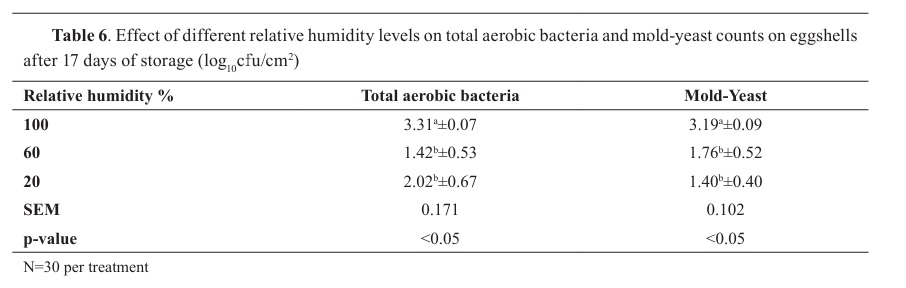
Microbiological counts on eggshellsThe effects of RH on total aerobic bacteria and mold–yeast counts on eggshells after 17 days of storage are presented in
Table 6. Relative humidity markedly influenced both microbial parameters (p<0.05). Eggs stored at 100% RH demonstrated the highest total aerobic bacterial load (3.31 log₁₀ CFU/cm²) and mold–yeast counts (3.19 log₁₀ CFU/ cm²). Conversely, eggs stored at 60% and 20% RH exhibited significantly reduced microbial loads, with no statistically significant difference observed between these two conditions.
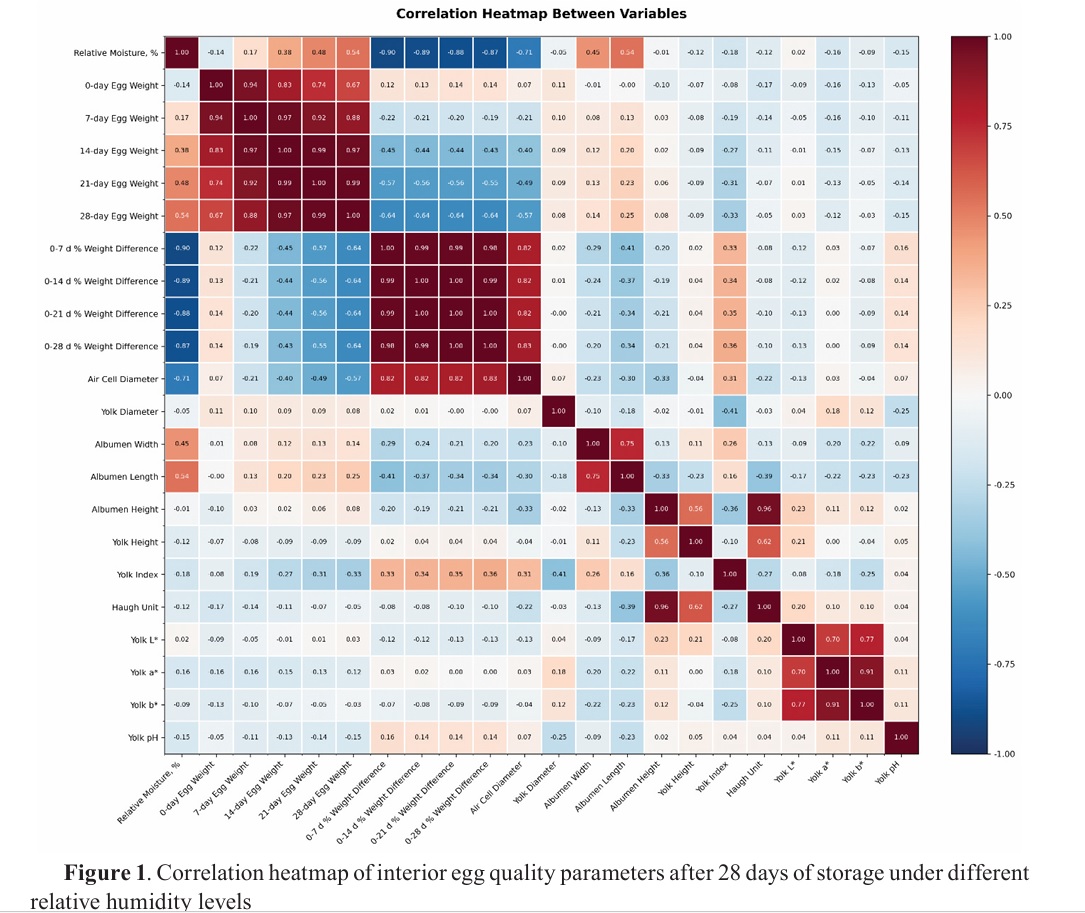
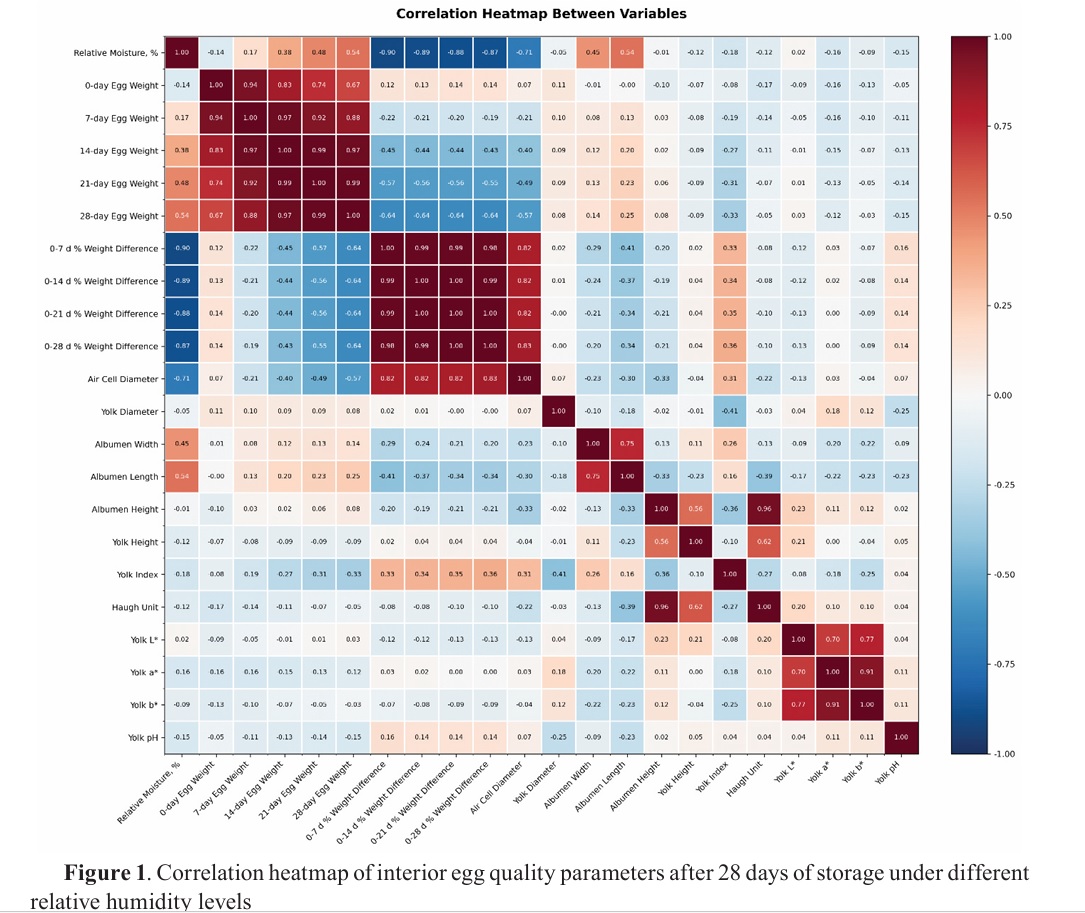
Correlation analysisThe correlation analysis of egg quality parameters measured after 28 days of storage is depicted in
Fig. 1. Robust positive correlations were observed among percentage weight-loss values across various storage intervals. The correlation between percentage weight loss at 0-14 days and 0-21 days was nearly perfect (r=0.9982). Likewise, percentage weight loss from 0-21 days showed a strong correlation with that from 0-28 days (r=0.9982). A significant correlation was also observed between percentage weight loss at 0-14 days and 0-28 days (r=0.9947). Furthermore, egg weights recorded at days 21 and 28 demonstrated a high degree of correlation (r=0.9939).
Relative humidity exhibited significant negative correlations with the percentage of weight loss across all storage durations, including 0-7 days (r=-0.9002), 0-14 days (r=-0.8916), 0-21 days (r=-0.8774), and 0-28 days (r=-0.8715). Furthermore, RH was significantly negatively correlated with air cell diameter (r=-0.7058), indicating reduced moisture loss and air cell expansion under elevated humidity.
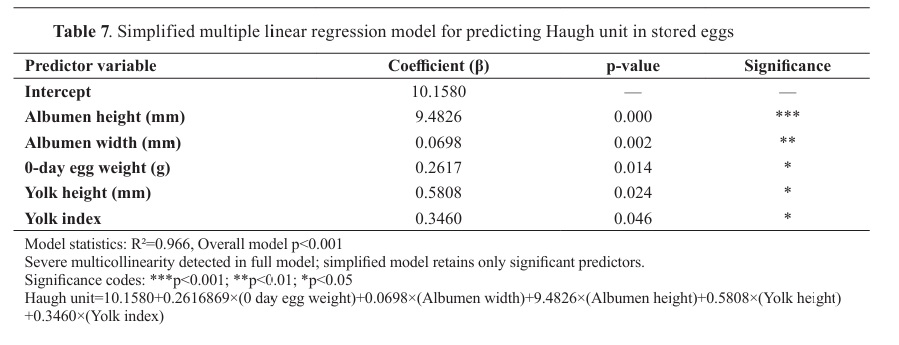
Multiple regression analysisA simplified multiple linear regression model was developed to identify the most significant predictors of the HU (refer to
Table 7). The reduced model demonstrated a high level of statistical significance (R²=0.966; p<0.001). Albumen height was identified as the most influential predictor of the HU (p<0.001), followed by albumen width (p=0.002), initial egg weight (p=0.014), yolk height (p=0.024), and yolk index (p=0.046). All regression coefficients were positive, indicating that increases in these parameters are associated with higher HU values. Although multicollinearity affected the overall regression model, the simplified model effectively highlighted the variables most relevant for predicting albumen quality post-storage.
 DISCUSSION
This study systematically examined the effects of three different RH levels (20, 60, and 100%) on the internal quality and microbiological safety of eggs stored at room temperature for 28 days. The results show that RH has a complex dual role in egg preservation, affecting both physicochemical degradation and the likelihood of microbial contamination.
Impact of relative humidity on egg weight loss and internal qualityAs anticipated, the greatest egg weight loss (5.9%) was recorded at the lowest RH level (20%), whereas the lowest loss (0.39%) occurred at 100% RH. This observation is consistent with the well established principle that water vapor loss through the eggshell is driven by the vapor pressure gradient between the egg interior and the surrounding environment (
5). Under low RH conditions, this gradient becomes steeper, accelerating moisture loss and leading to air cell enlargement. Conversely, high RH reduces the vapor pressure deficit, thereby limiting water loss and maintaining egg weight.
Nonetheless, the relationship between weight reduction and internal quality parameters was not strictly linear. The most significant decline in albumen quality was observed at 60% RH, where both albumen height and HU reached their minimum values. Generally, excessive moisture and carbon dioxide (CO₂) loss during storage are acknowledged to promote albumen thinning and a reduction in HU (
10, 23). Interestingly, eggs stored at 20% RH retained comparatively high HU values despite experiencing considerable weight loss. This indicates that, under extremely dry conditions, water loss may occur more rapidly than CO₂ diffusion, which is regarded as a primary factor in albumen alkalization and thinning (
3, 10). Alternatively, very low RH levels may stabilize albumen protein interactions, particularly between ovomucin and lysozyme, thereby retarding structural deterioration (
24).
In contrast, the intermediate RH condition (60%) was the least effective in maintaining albumen quality, suggesting that moderate humidity levels may promote CO₂ diffusion relative to water loss, thereby resulting in a deterioration of the albumen structure. This observation underscores the intricate interaction between moisture loss, gas exchange mechanisms, and protein stability throughout egg storage (
25, 26). The lower HU observed at 60% RH compared to 20% RH may be explained by the specific interaction between moisture loss and gas exchange mechanisms. At the intermediate level of 60% RH, the moderate vapor pressure deficit likely promotes a more efficient diffusion of CO₂ relative to water loss, which accelerates albumen alkalization and the subsequent thinning of the thick albumen (
10, 23). Conversely, the rapid dehydration occurring at 20% RH may induce a “concentration effect” within the albumen matrix, physically stabilizing the interaction between ovomucin and lysozyme and potentially retarding the rate of CO₂ diffusion through the shell membranes (
3, 24). This suggests that while 60% RH facilitates the biochemical processes leading to albumen deterioration, the extreme dryness at 20% RH creates a physical environment that paradoxically helps maintain the structural integrity of the albumen despite significant weight loss (
25, 26). The relatively poor albumen quality observed at 60% RH indicates that intermediate humidity levels may not provide optimal conditions for preserving internal egg quality. Further studies are warranted to clarify the mechanisms governing CO₂ diffusion, moisture dynamics, and protein stability under moderate humidity conditions.
Morphological albumen measurements further supported these observations. Eggs stored at 20% RH exhibited significantly reduced albumen length and width, indicating a more compact and less hydrated albumen matrix. This structural compactness may contribute to maintaining albumen height and HU despite high overall moisture loss. Yolk traits were generally less sensitive to RH than albumen-related characteristics. However, yolk redness (a*) was significantly higher in eggs stored at 20% RH, likely due to pigment concentration effects of carotenoids associated with dehydration. Meanwhile, the yolk index was lowest at 100% RH, suggesting a weakening of the vitelline membrane under highly humid conditions, likely due to increased water migration from the albumen to the yolk driven by osmotic pressure (
27, 28, 29). Notably, yolk pH remained unaffected by RH, indicating that the dynamics of CO₂ exchange may vary between egg compartments or that the impact of RH on yolk pH is comparatively limited in relation to its influence on albumen quality. Comparable findings have been documented in previous research examining gas exchange and internal egg chemistry during storage (
30).
Microbiological safety and edibilityFrom a food safety standpoint, the most noteworthy discovery was the considerable decrease in the quantity of eggs suitable for consumption at 100% RH. Only 37% of eggs stored under saturated humidity conditions remained fit for consumption after 28 days, in contrast to 97–100% in the groups maintained at 60% and 20% RH. This finding supports the hypothesis that elevated humidity levels promote conditions favorable to microbial proliferation on the eggshell surface (
12).
Microbiological analyses confirmed that eggs stored at 100% RH demonstrated significantly higher levels of aerobic bacteria and molds/yeasts. In alignment with previous research, increased humidity promotes fungal growth and, in some cases, penetration into the egg’s interior, thereby leading to spoilage or mycotoxin formation (
12, 31). Moist shell surfaces enhance microbial adhesion, germination, and proliferation, and may also facilitate microbial penetration through shell pores or microcracks (
32).
Conversely, eggs stored at 20% RH showed minimal microbial growth, supporting the hypothesis that a dry shell environment inhibits microbial proliferation. The absence of significant differences in microbial counts between the 20% and 60% RH groups indicates that moderate humidity levels do not markedly increase contamination risk within the examined storage duration and conditions. In contrast, saturated humidity distinctly enhances food safety risks. These findings indicate that minimizing weight loss alone should not be considered an adequate indicator of successful egg storage, as preservation of microbiological safety is equally essential.
Although maintaining a RH of 100% effectively prevents moisture loss, it leads to unacceptable microbiological deterioration. Consequently, the regulation of RH during egg storage must strike a balance between conserving physicochemical properties and controlling microbial proliferation.
Interrelationships of quality parametersCorrelation analysis revealed significant inverse relationships between RH and percentage weight loss across all storage intervals, thereby confirming that higher humidity reliably reduces moisture loss. Additionally, a notable negative correlation was observed between RH and air cell diameter, further corroborating the impact of environmental moisture on evaporation.
Strong positive correlations were observed between albumen height and HU, reaffirming the well-established significance of albumen structure as the primary determinant of internal egg quality (
33). These relationships were further corroborated through the simplified multiple linear regression analysis, where albumen height was identified as the most influential predictor of HU, followed by albumen width, yolk height, yolk index, and initial egg weight. Similar findings have been documented in both chicken and quail eggs, emphasizing the robustness of albumen height as an indicator of freshness across various species and storage conditions (
34, 35).
The inclusion of initial egg weight as a predictor suggests that the original egg size may influence the rate of quality deterioration during storage, potentially owing to differences in albumen-to-yolk ratios or shell characteristics (
19). The final regression model was biologically plausible and demonstrated significant explanatory power, offering a practical approach for predicting internal egg quality based on a limited set of measurable parameters. Future research should investigate the combined effects of RH, storage temperature, packaging systems, and shell surface treatments to further optimize egg quality preservation and microbiological safety during prolonged storage.
CONCLUSIONIn conclusion, RH significantly influenced both the internal quality and microbiological safety of eggs during 28 days of storage at room temperature. Storage at 20% RH provided the best preservation of egg quality, maintaining higher HU values and lower microbial contamination despite greater weight loss. In contrast, storage at 100% RH minimized weight loss but resulted in increased bacterial and mold contamination and a higher incidence of spoiled eggs. These findings indicate that preserving egg quality requires consideration of both internal quality and microbiological safety, and that low-humidity storage (approximately 20% RH) provides the most favorable conditions for prolonged egg storage.
CONFLICT OF INTERESTThe authors declare that they have no financial or non-financial conflict of interest regarding authorship and publication of this article.
ACKNOWLEDGMENTSThe authors gratefully acknowledge the staff of the Poultry Unit, Faculty of Veterinary Medicine, Istanbul University-Cerrahpaşa, Türkiye, for their valuable assistance with egg collection and handling throughout the study. This research received no external funding.
AUTHORS’ CONTRIBUTIONAYP and AEY conceptualized the study, carried out and supervised the sample analysis, prepared graphs and tables, and wrote the manuscript. AK and AA were included in the hypothesis formulation. AA participated in editing the manuscript and contributed to the practical performance of this research. All authors have revised and approved the final version of the manuscript.


 10.2478/macvetrev-2026-0022